
KADESH,
Sanctification of the Day
Leader
Welcome to our Passover Seder.
Together with Jews everywhere, we recount
tonight a story told every year for the last 3000 years; a story about
the community of Israel eternally linked with humanity's divine passion
for justice and liberty. We remember the event that became the great
symbol of liberation--the Exodus from Mitzrayim, the "narrows"
of the biblical land of Egypt. Tonight we remember our ancestors.
We vow that we will not allow their stories, their experiences, their
wisdom to be taken from us. It is our legacy and we will study it
and teach it to our friends and to our children. For it is written:
Group
You shall keep the Feast of Unleavened Bread, for on this very day
I brought your hosts out of Mitzrayim. You shall observe this
day throughout the generations as a practice for all times.
Leader
We assemble in fulfillment of the mitzvah:
Group
Remember the day on which you went forth from Mitzrayim, from
the house of bondage, and how Adonai freed you with a mighty hand.
Lighting the Festival Candles
Leader
Our Seder starts with the lighting of two candles accompanied by a
blessing. It is traditionally done by the mother of the house.
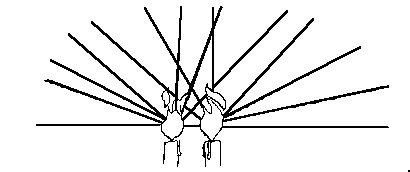
(The candles are lit as the blessing is recited.)
Mother of the house
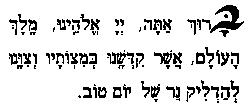
Baruch Atah Adonai Eloheinu Melech
ha-olam, asher kid-shanu b'mitz-vo-tav, v'tzi-vanu
l'hadlik neir shel yom tov.
In praising God we say that all life is sacred.
In kindling festive lights, we preserve life's sanctity.
With every holy light we kindle,
the world is brightened to a higher harmony.
We praise You, Adonai, majestic Sovereign of all Life,
Who hallows our lives with commandments
and bids us kindle festive holy light.
The First Cup--the Cup of Sanctification
Leader
Four times, in the course of this Seder, we partake of the wine, symbol
of joy and thanksgiving. The four cups represent the four-fold promise
which Adonai our God made to the Israelites in Mitzrayim. With
each cup we recall one of the promises.
Group
"I will free you from the forced labor of the Egyptians."
Leader
We take up the Kiddush cup and proclaim the holiness of this
Day of Deliverance!
Group
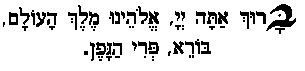
Baruch Atah Adonai Eloheinu Melech ha-olam,
borei p'ri ha-gafen.
We praise You, Adonai, Sovereign of Life, who creates the fruit of
the vine!
Participant
We praise You, Adonai, Sovereign of Life!
You have called us for service from among the peoples,
and have hallowed our lives with commandments.
In love You have given us festivals for rejoicing,
seasons of celebration, this Festival of Matzot,
the time of our freedom, a day of sacred assembly
commemorating the Exodus from Mitzrayim.
Praised are You, who gave us this joyful heritage
and who sanctifies the people of Israel, and the festival days.
Leader
We have thanked Adonai for the commandments which add holiness
to life, for the wine which adds joy to life, and for the festivals
which add beauty to life. Now let us thank Adonai for the wonder of
life itself.
Group
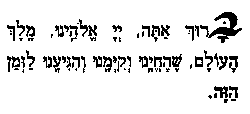
Baruch Atah Adonai Eloheinu Melech
ha-olam, she-heh-che-yanu, v'ki-y'manu, v'higi-anu lazman
hazeh.
We praise You, Adonai, Sovereign of Life,
for giving us life,
and keeping us alive,
so we may celebrate this season of joy.

(All drink the first cup of wine.)

UR-HATZ,
Washing the Hands
Leader
Traditionally, the high priests in the Temple washed their hands
before all holy duties. We will wash our hands now to help us feel
that holiness, but since we will not be eating just yet, we won't
recite the hand-washing blessing.

KARPAS,
Rebirth and Renewal
Leader
All holidays have their origins in nature and the seasonal changes,
and people throughout the world celebrate similar festivals at roughly
the same time throughout the year. Like all people, our people in
ancient, pastoral times celebrated the liberation of the earth itself
from wintry darkness, and rejoiced in the yearly rebirth of nature.
In the spring of the year, the season of rebirth and renewal, on the
festival Pesach, we read from the Song of Songs.
Participant
Come, my beloved, my lovely one, come.
Behold, winter is past, the rains are over and gone.
Flowers appear on the earth.
The season for singing has come,
and the song of the turtledove is heard in our land.
The fig tree is forming its first green figs
and the blossoming vines smell oh so grand.
Come then, my beloved, my lovely one, come.
Participant
Come, my beloved, let us go to the fields.
We'll spend the night in the village,
and in early morn we'll visit the vineyards.
We'll see if the grapes have blossomed,
if the pomegranate trees are in flower.
For then shall I give you the gift of my love.
Group
O women of Jerusalem,
Swear by the wild field doe
That you will not disturb us
Till we fulfill our love.
Leader
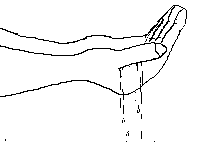
We dip karpas, greens, symbol of the renewal of the earth at
springtime, into salt water, symbol of the bitter tears shed by the
slaves in Mitzrayim. This, the first dipping of the Seder,
evokes the imagery of the birth of the Jewish people at the time of
the Exodus.
Group
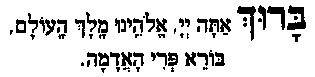
Baruch Atah Adonai Eloheinu Melech ha-olam,
borei p'ri ha-adamah.
We praise You, Adonai, Sovereign of Life,
Who creates the fruit of the earth.

(Each person takes some greens, dips them in salt water,
and eats them.)
YACHATZ,
A Bond Formed by Sharing
Leader
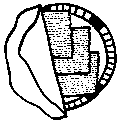 We take the middle of the three matzot and break it in two.
The smaller piece is replaced between the other two matzot.
The larger piece is wrapped in a napkin and set aside as the "afikomen"
from a Greek word that means dessert. Later we will share it, just
as in days of old the Paschal lamb offering itself was shared during
this service at the Temple in Jerusalem. Among people everywhere,
sharing of bread forms a bond of fellowship.
We take the middle of the three matzot and break it in two.
The smaller piece is replaced between the other two matzot.
The larger piece is wrapped in a napkin and set aside as the "afikomen"
from a Greek word that means dessert. Later we will share it, just
as in days of old the Paschal lamb offering itself was shared during
this service at the Temple in Jerusalem. Among people everywhere,
sharing of bread forms a bond of fellowship.
For the sake of our redemption we say together the ancient words which
join us with our own people and with all who are in need, with the
wrongly imprisoned and the homeless. For our redemption is bound up
with the deliverance from bondage of people everywhere. Now let us
repeat, in ancient Aramaic, the call to Pesach.
Group

Ha lachma anya dee a-cha-lu a-va-ha-sa-na b'ara d'mitzrayim.
This is the bread of affliction, the poor bread our ancestors ate
as slaves in the land of Mitzrayim.

Kol dichfin yay-say v'yaychul; kol ditzrich yay-say
v'yifsach.
Let all who are hungry come and eat. Let all who are needy share the
hope of this Passover celebration.

Ha-shata hacha, l'shana ha-ba'ah b'ara d'Yisrael.
This year we are here. Next year may we be in the land of Israel.

Ha-shata avday, l'shanah ha-ba'ah b'nay chorin.
This year we are all still in bonds. Next year may all be free.
Back to Introduction |
On to Part II
Last update: March 3, 1999
Created and maintained by Bob Parnes
Please send your comments to bparnes@umich.edu
|